Why Certain Fires Stay With You Forever (And Others Disappear by Sunrise)
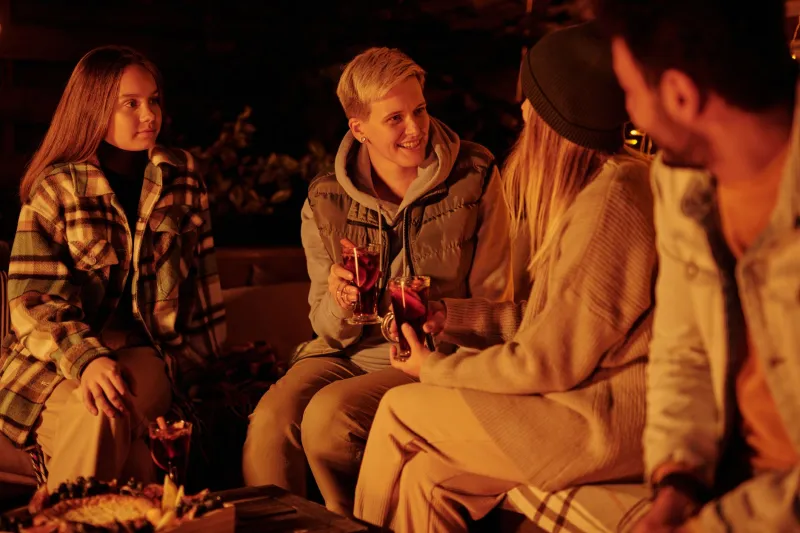
You've probably had dozens of bonfires. Maybe hundreds. And if you're honest with yourself, most of them have blurred together into a soft, warm haze — vague impressions of smoke and laughter and cold drinks. But then there are those fires. The ones that live in you like a scar, except the good kind. The ones you can still smell when you close your eyes.
What separates them? What makes one night around the flames a lifetime memory and another just... Tuesday?
It turns out the answer isn't as simple as "good people" or "perfect weather." The fires that last are built from something more complicated — and more beautiful — than that.
Your Brain Is Picky About What It Keeps
Here's the thing about memory: it doesn't work like a camera. Your brain isn't recording everything and filing it away. It's actively deciding what's worth keeping, and it uses a few specific signals to make that call.
Emotion is the biggest one. When something makes you feel deeply — whether that's joy, vulnerability, awe, or even a little grief — your brain tags that moment as important. The neurological process involves your amygdala essentially stamping a memory with a "save this" flag. Ordinary nights don't get the stamp. Extraordinary ones do.
But here's what's interesting: the "extraordinary" doesn't have to come from big, dramatic events. A quiet confession shared between two people at the edge of the fire circle can hit harder than a fireworks show. A song that plays at exactly the right moment. A stranger who says something that rewires how you see yourself. The brain doesn't care about spectacle. It cares about meaning.
The Element Nobody Plans For: Timing
Ask anyone about their most memorable bonfire night, and somewhere in the story, timing will show up. It was the last weekend before someone moved away. It was the night after a hard week that finally broke open into something good. It was the first real warm night after a brutal winter.
Transitional moments in life make us more emotionally receptive. We're paying closer attention. Our defenses are a little lower. We're more likely to say the thing we've been holding back, or to actually hear what someone else is saying.
This is why bonfires at the end of summer hit differently than bonfires in June. There's a weight to them. Everyone at the circle knows, on some level, that the season is closing. That awareness turns up the volume on everything — the laughter feels more necessary, the silences feel more loaded, and the fire itself seems to burn with a little more urgency.
You can't manufacture that timing. But you can learn to recognize it when it shows up.
Who's in the Circle Matters More Than You Think
The people around a fire don't just contribute to the atmosphere — they actively shape what's possible. A circle full of people who are half-checking their phones, or who don't really know each other, or who are performing for an invisible audience, puts a ceiling on how deep the night can go.
The fires that become legendary tend to have a specific mix: at least a few people who are genuinely present, at least one person willing to go first (to be vulnerable, to be weird, to ask the real question), and just enough unfamiliarity to keep things interesting without tipping into awkward.
Old friends who've run out of small talk. A new person who asks questions nobody thought to ask. Someone going through something real who doesn't hide it. These are the ingredients that make a circle feel alive.
There's also something to be said for the right size. Research on group dynamics consistently shows that deeper conversations happen in smaller groups. Once a bonfire grows past a certain point, it tends to fracture into smaller clusters anyway — but those clusters are where the real magic lives. If you want a night that sticks, don't be afraid of keeping it small.
Weather Isn't Just Background — It's a Character
A crisp October night in the Midwest. A beach bonfire on the Carolina coast with the wind coming in off the water. A fire in a backyard in New England while the first snow of the season dusts the lawn. Weather doesn't just set the mood — it makes the fire feel earned.
Discomfort, believe it or not, is a memory-maker. When you're a little cold, or the wind keeps shifting the smoke toward your face, or you have to huddle in closer than you normally would, you're creating shared experience. You're bonding through mild adversity. And your brain, once again, marks the moment as worth keeping.
Perfect, comfortable, climate-controlled settings tend to produce forgettable nights. The fires we remember are usually the ones where something was slightly out of our control — and we leaned in anyway.
The Moment That Cracks Everything Open
Every truly legendary bonfire has a hinge point. A moment where the night shifts from social gathering to something more. It could be a conversation that finally goes somewhere real. A song that makes everyone go quiet. A joke that lands so perfectly that the laughter goes on longer than it should. A moment of shared awe — a meteor, a shooting star, the fire collapsing in on itself in a way that looks almost alive.
These hinge moments can't be forced, but they can be created by the conditions around them. Phones put away. Enough time for the group to settle in and stop performing. Someone willing to ask a better question than "so what do you do?"
The fires that fade by morning are the ones where no hinge moment ever arrives. Everyone stayed comfortable, stayed surface-level, stayed safe. And there's nothing wrong with that — sometimes a chill night is exactly what you need. But it won't be the story you tell at the next bonfire.
How to Give a Night the Best Chance
You can't guarantee a legendary fire. But you can stack the odds.
Keep the circle small enough for real conversation. Put something at stake — a meaningful occasion, an honest question, a tradition that matters. Let the fire breathe instead of rushing to fill every silence. Invite at least one person who challenges the group just enough. And show up with something to say, not just something to post.
Most importantly, be the person who goes first. The fires that last are always started by someone willing to show up fully — not just to stand near the heat, but to actually be in it.
The flame doesn't do the work. The people do. But every once in a while, when everything lines up just right, you get both — and that's the night that stays with you forever.
Gather around. Every moment matters. But some moments? They matter for a lifetime.