Fire Light, Real Talk: How to Navigate Tough Conversations Around the Bonfire
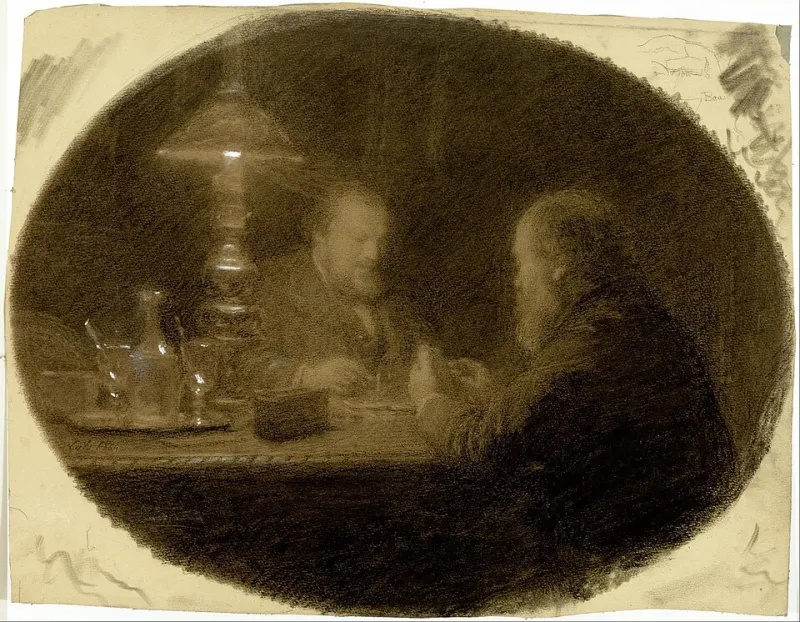
Photo: Adolphe-Félix Cals, Public domain, via Wikimedia Commons
You've been there. Everyone's settled in, the fire is doing its thing, and suddenly the moment feels almost right to bring up the thing you've been sitting on for weeks. Maybe it's an apology you owe someone. Maybe it's a friendship that's been fraying at the edges. Maybe it's something heavier—a family tension, a life decision, a confession that's been burning a hole in your chest longer than the wood has been burning in that pit.
Bonfires have a weird way of doing this to people. And honestly? That's not an accident.
Why the Fire Makes You Want to Go There
There's a reason people have been gathering around fires to talk since, well, forever. The combination of low light, ambient noise, and the natural draw of the flame creates what psychologists sometimes call a "liminal space"—a moment that feels slightly outside of normal time and social rules. You're not at the office. You're not at a dinner table where eye contact is unavoidable. You're somewhere in between, and that in-between feeling loosens things up.
The semi-darkness helps, too. Research has shown that people are more likely to open up emotionally when they're not under full, direct lighting. Think about it: therapists don't conduct sessions under fluorescent lights for a reason. There's something about being partially shadowed that lowers the stakes of what you say. Your face is harder to read. The other person's reaction is softened by the glow. It feels, at least in the moment, like there's a little more room to breathe.
And then there's the fire itself. Having something to look at—something that moves and shifts and demands a little passive attention—takes the pressure off direct conversation. You don't have to lock eyes. You can say something real and then just... stare into the flames for a second. That pause doesn't feel as loaded as it would across a kitchen table.
The Problem: It's Still a Group Setting
Here's the catch. All of those psychological conditions that make a bonfire feel like a safe space for honesty? They exist alongside a very real social reality: there are other people around.
Bringing up something heavy in a group setting is a completely different animal from a one-on-one conversation. Even if the fire makes you feel like you're in your own private bubble with the person next to you, you're not. Other people hear things. Other people react. And once a heavy topic hits the air around a bonfire, it tends to shift the entire energy of the night—sometimes in ways that are hard to recover from.
That's not a reason to never go there. It's just a reason to be intentional about how you do it.
Strategies for Bringing Up the Hard Stuff
Pick your moment carefully. The best time to nudge toward a serious conversation is not when the group energy is at its peak—when people are laughing, music is going, drinks are flowing. Wait for a natural lull. When the fire settles into a quieter burn and conversation drifts, that's when the door is most naturally open.
Use the fire as an ally. Instead of pivoting sharply into serious territory, let the atmosphere do some of the work. A lot of meaningful bonfire conversations start with something small—a question, a half-observation, a "hey, can I ask you something?"—that invites the other person in without announcing that a Big Conversation is about to happen. Lower the entrance barrier.
Know whether this is a group conversation or a private one. Some things genuinely need to be said to one specific person and should not be aired in front of the whole circle. If that's the case, a bonfire is still a useful setting—but step away from the group. Take a short walk. Grab a drink together. The fire is still there in the background doing its psychological work, but you've removed the audience. That changes everything.
Give people an out. Heavy conversations that feel forced or cornered rarely go well. If you're raising something difficult, make it clear—even subtly—that the other person has room to say "let's talk about this later" without it being a rejection. Sometimes the bonfire isn't the right moment, and respecting that actually builds more trust than pushing through.
Don't mistake the atmosphere for permission. The fire makes things feel safe, but it doesn't make them consequence-free. Confessions, apologies, and confrontations still land. The warmth of the setting doesn't soften the impact of the words themselves. Be as thoughtful about what you say as you are about when you say it.
What to Do When It Gets Awkward
Sometimes, despite your best instincts, a conversation goes sideways. Someone shuts down. Someone else in the circle picks up on the tension. The vibe shifts. It happens.
The instinct is usually to either double down or completely retreat. Neither tends to work. Instead, try a soft pivot—acknowledge the moment without making it bigger. Something like, "We can come back to that" or "I just wanted to say it out loud" gives the conversation a place to rest without forcing a resolution right then and there. Bonfires are long. There's time.
And sometimes the most honest thing you can do is let the fire hold the silence for a minute. Not every heavy moment needs to be immediately smoothed over. People are allowed to sit with something. That's part of what gathering around a fire is actually for.
The Bonfire as a Container
The communities that build the best bonfire cultures—the ones where people actually show up consistently, where the circle keeps growing—tend to understand something important: the fire creates a container. It holds what people bring to it. Laughter, music, silence, grief, celebration, confession. All of it can live there.
But like any container, it has limits. Bring too much too fast, and things overflow. The goal isn't to avoid real conversation—it's to bring it in a way that honors both the moment and the people in it.
So yeah, if you've been carrying something you need to say, the bonfire might be exactly the right place to say it. Just bring it with care. The fire's been keeping people honest for thousands of years. It can handle your truth. The question is whether you're ready to offer it up right.