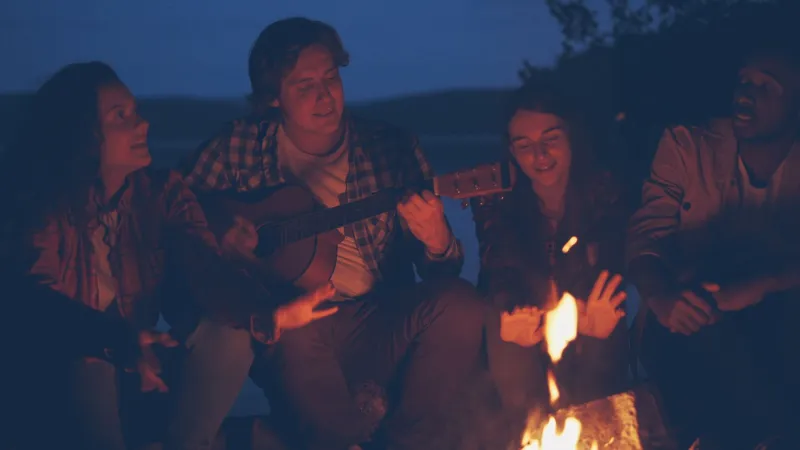
Know the Rules Before You Pull Up a Chair: Bonfire Etiquette Everyone Should Know
Photo: Basile Morin, CC BY-SA 4.0, via Wikimedia Commons
Nobody sends out a rulebook with the bonfire invite. There's no orientation, no orientation packet, no laminated card propped against the cooler that explains how things work. And yet, somehow, a good bonfire runs on a surprisingly consistent set of unwritten agreements — social contracts that most people absorb through experience rather than instruction.
The problem? Not everyone's had enough bonfires to absorb them yet. And even the veterans sometimes need a reminder.
This isn't about being uptight. Bonfire culture is, at its core, one of the most relaxed and welcoming social formats humans have ever invented. The whole point is to gather, slow down, and actually be present with each other. But that ease doesn't happen automatically — it's built on mutual respect, a few practical courtesies, and a shared understanding of what a bonfire is actually for.
So whether you're hosting for the first time or you've been pulling up lawn chairs since high school, here's the honest breakdown of how it works.
The Fire Is Not a Democracy (But It's Also Not a Dictatorship)
Let's start with the fire itself, because it sets the tone for everything else.
The person who built the fire — or whose yard it's in — has the final say on how it's managed. That's just reality. They know the pit, they know the wood, they know how the fire behaves in that specific spot. If they say "don't add that log yet" or "we're keeping it small tonight," respect that call without commentary.
At the same time, a good host doesn't hoard the fire duties like a dragon sitting on gold. If someone wants to learn, let them try. If someone has a genuine suggestion, hear it out. The fire is a shared focal point — treat it like one.
What you should never do: walk up and start rearranging the wood without asking, toss in random debris (cardboard, plastics, anything that's going to smoke everyone out), or treat the fire like your personal project when it's clearly someone else's gathering.
BYOB Expectations Are Real — Honor Them
The invite said BYOB. That means bring your own beverages — enough for yourself, and ideally a little extra in the spirit of generosity. It does not mean show up empty-handed and work your way through everyone else's cooler for three hours.
If you genuinely couldn't make it to the store, say something when you arrive. Most people will wave it off because most people are decent. But showing up empty-handed without acknowledgment, and then drinking freely, is the kind of thing that gets noticed even when nobody says anything.
On the flip side, hosts: if you've got extra and you want to share, share freely. Don't keep a running tab in your head. The whole vibe of a bonfire is abundance and openness — if you're going to invite people, commit to that spirit.
Seating Is More Complicated Than It Looks
This one sounds trivial until you've watched it go sideways.
When you arrive, take a seat somewhere that doesn't block the fire view for the people already there. Don't plant yourself in the prime spot directly in front of the fire if the gathering is just getting started and there are still people to arrive. Leave room. Be aware of the circle.
If someone's been in a chair for an hour and steps away to grab a drink, that's still their chair. Don't take it. Don't put your stuff on it. A bonfire seat is not like a table at a busy restaurant — there's no turnover policy.
And if you brought your own chair? Bring one that's appropriate for the setting. A camping chair or a simple folding chair is perfect. Rolling up with a massive recliner or a lawn chair that takes up the space of three people is, at best, an interesting choice.
Your Phone Is a Guest, Not a Co-Host
Here's the honest truth: constant phone usage at a bonfire is a mood killer. Not because phones are inherently evil, but because bonfire culture is specifically about presence — about the kind of slow, face-to-face connection that's increasingly rare in daily life.
Checking your phone occasionally is fine. Taking a photo of the fire, the group, the sparks flying up into the dark sky? Absolutely, go for it — those are the memories worth capturing. But sitting in the circle with your face buried in a screen for extended stretches sends a message to everyone around you, whether you intend it or not.
The message is: this isn't worth my full attention.
And a bonfire, at its best, is absolutely worth your full attention.
Conversation Etiquette: The Bonfire Isn't a Stage
Good bonfire conversation has a rhythm to it. It flows, it wanders, it doubles back. Multiple threads often run at once. Someone tells a story, someone else riffs on it, a third person brings up something completely different, and somehow it all connects.
What disrupts that rhythm is one person dominating the conversation for too long, or someone who consistently redirects every topic back to themselves, or — and this one's subtle — someone who talks at the fire rather than to the people around it.
Be curious. Ask questions. Let the quiet moments breathe. Some of the best bonfire conversations happen in the gaps.
Also: if someone's clearly processing something heavy, don't push. Bonfires have a way of drawing out honesty, and not everyone's ready to go there publicly. Read the room.
Guests: Help Out Without Being Asked
If you see the wood pile getting low, offer to grab more. If someone's drink is empty and you're headed to the cooler anyway, ask if they want anything. If trash is accumulating near the fire and there's a bag nearby, be the person who handles it.
Nobody's keeping score, and nobody expects you to be the designated helper all night. But a bonfire is a communal experience, and small acts of consideration go a long way. They also tend to be contagious — one person stepping up usually inspires a few others to do the same.
Knowing When to Leave Is a Skill
This might be the most underrated piece of bonfire etiquette, and it applies to guests and hosts alike.
For guests: when the fire starts dying down and the host stops adding wood, that's usually a signal. When yawning becomes the dominant group activity, that's a signal. When the host starts making moves toward cleaning up, that's a very clear signal. You don't have to be the first person to leave, but you also don't need to be the last one standing at 2 a.m. when your host has work in the morning.
For hosts: it's okay to call it. A simple "I think we're wrapping up in about 30" gives people time to finish conversations, say goodbyes, and make their exit without it feeling abrupt. You don't have to wait until everyone leaves on their own — it's your fire, your yard, your call.
The Bottom Line
Bonfire etiquette isn't about following a strict code. It's about showing up with the same intention that makes bonfires worth having in the first place: to be genuinely present with the people around you, to contribute more than you take, and to treat the gathering — and everyone in it — with a little care.
Do that, and you'll always be someone people want to see pull up a chair.